At the end of our last entry I promised a tale of three cities but, once I started writing, I realized that just covering our one day in Bonifacio was going to be a long post and decided, for the sake of you readers, to break this into two or three pieces. This way, you’ll end up reading the same amount of text but in shorter, more digestible portions. Besides, the count had already climbed to four cities worth writing something about and that exhausted even me so let’s just start with chapter one.
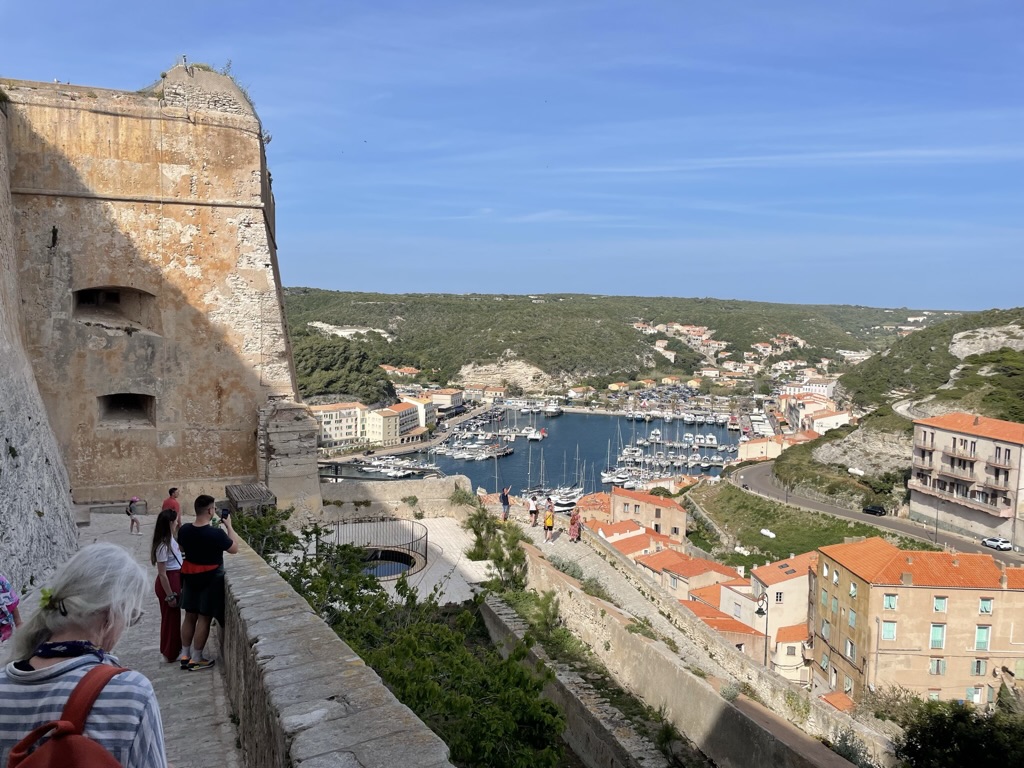
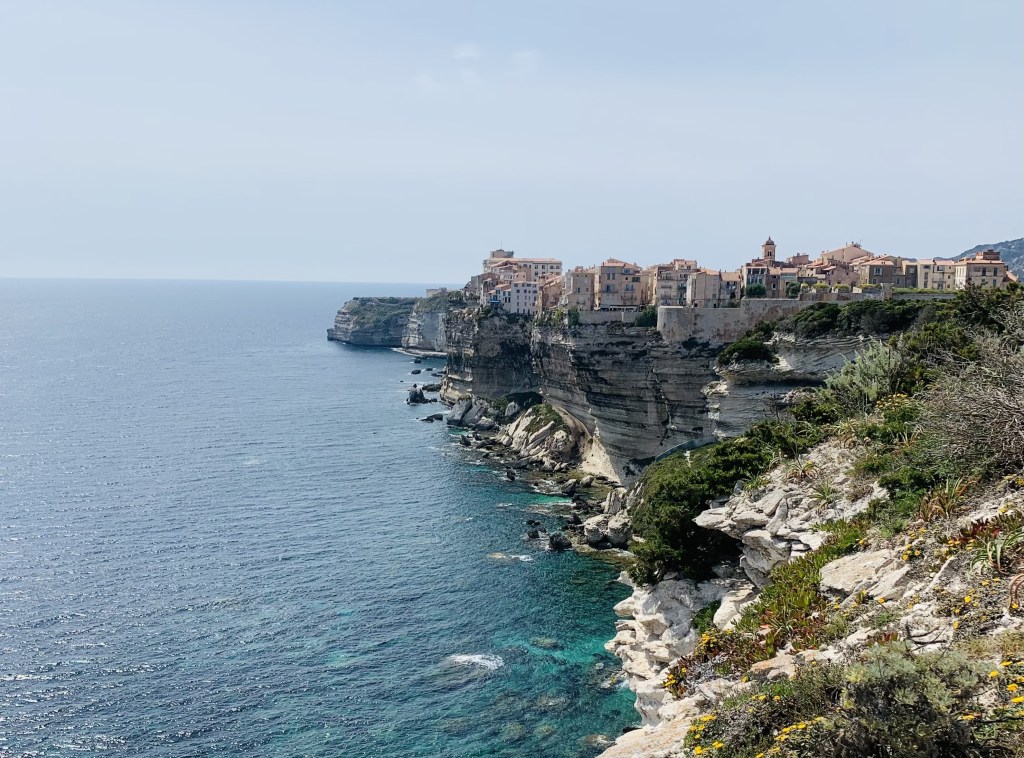
Denise and I decided to tackle the southern port town of Bonifacio on a weekday, hoping to avoid the worst of the crowds. It’s a two and one-half hour drive from Ajaccio on winding, mountain roads and our ambitious plan was to arrive in time for lunch by the harbor, tour the citadel and the old town, then arrive back home before dark. Bonifacio is a striking place, with the upper village seemingly hanging over the sea on a limestone promontory with the lower part of town – the Marine — hugging a tidy harbor, and it attracts visitors from all over the world. We didn’t think that all those visitors would be there on the same Tuesday but you live and learn.
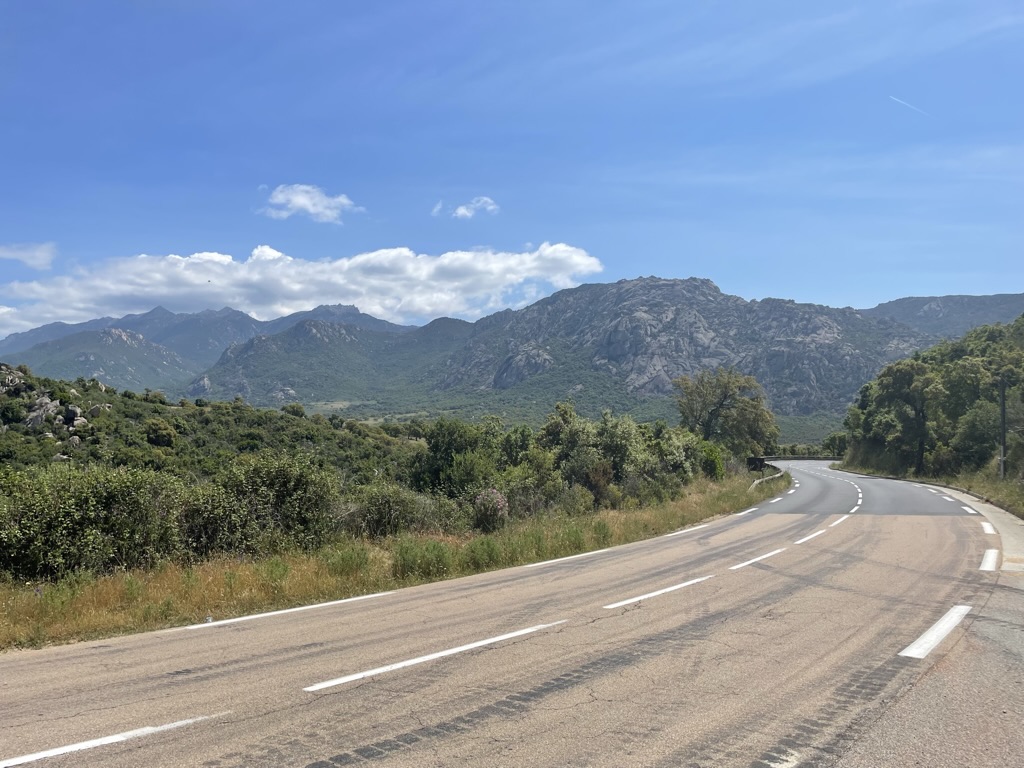
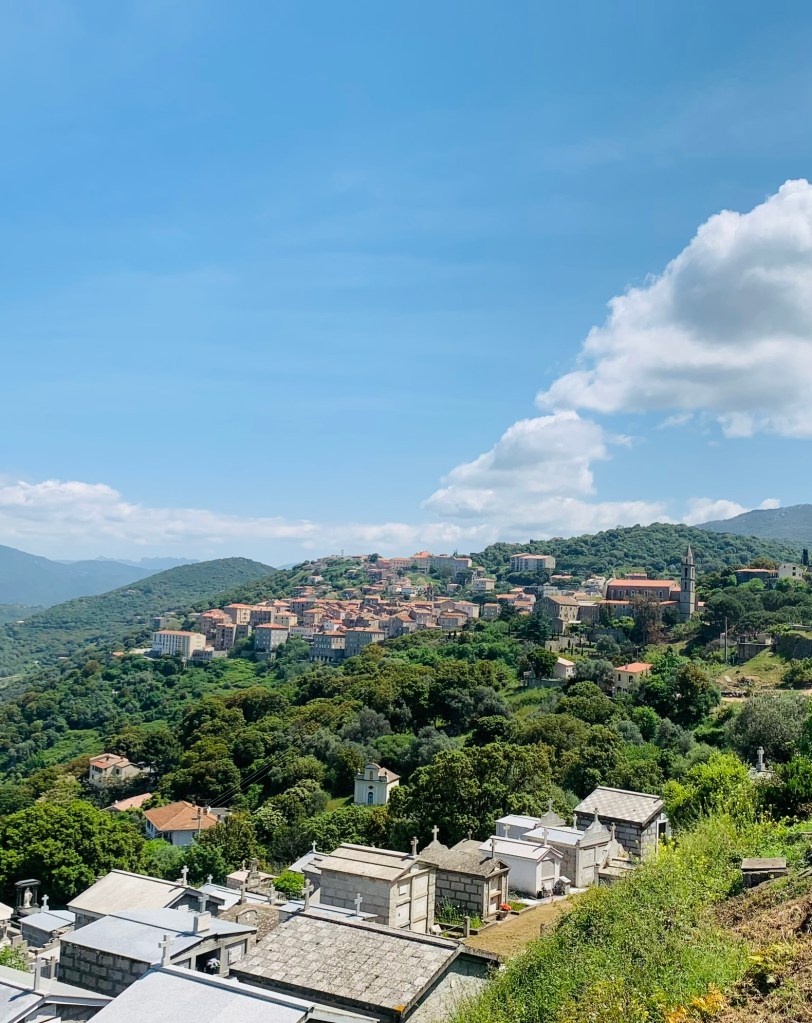
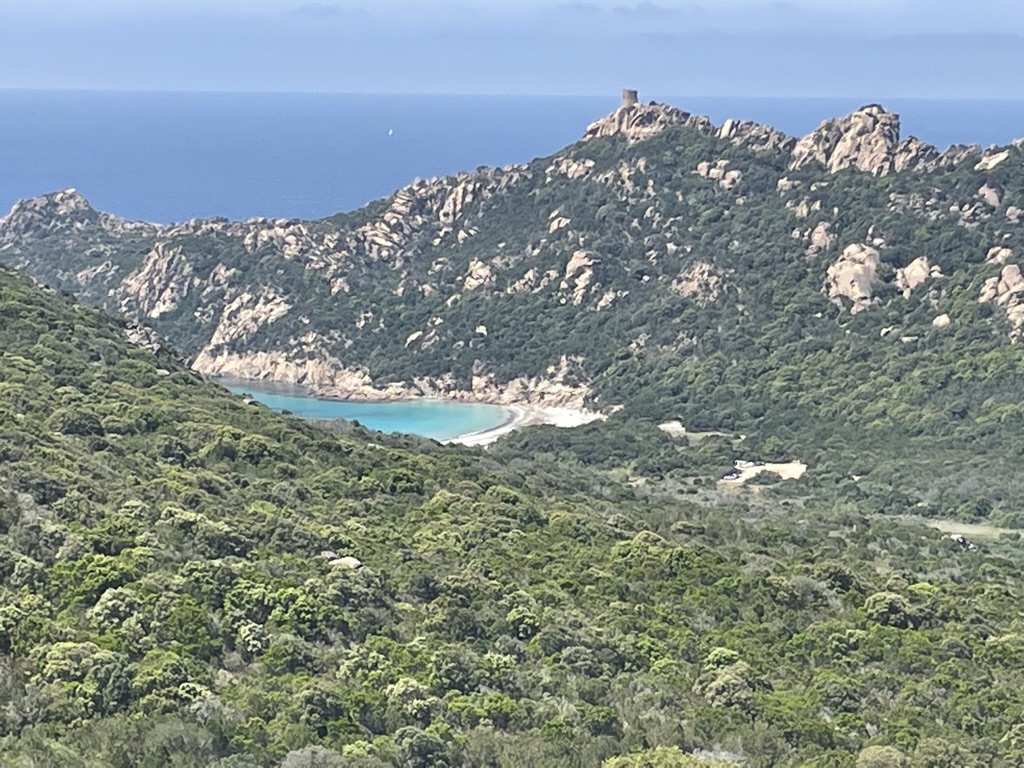
The drive down was distractingly beautiful, causing us to frequently pull over to the side of the road in order to admire the views. This was our first trip into the mountainous middle of Corsica and the roads switched back constantly, with each vista topping the last. Particularly beautiful was the hillside town of Sarténe, and we couldn’t resist making a brief detour there to take in the outskirts. We finally arrived in Bonifacio about 90 minutes later than planned, and dangerously close to the end of the generous French lunch break. We hadn’t expected parking to be an issue but, after being waved away from a few full lots, we were flummoxed. There were only six public parking lots in the compact city and all the ones by the harbor were full. I’m usually obsessive about planning for parking but I definitely fumbled the ball on this one.
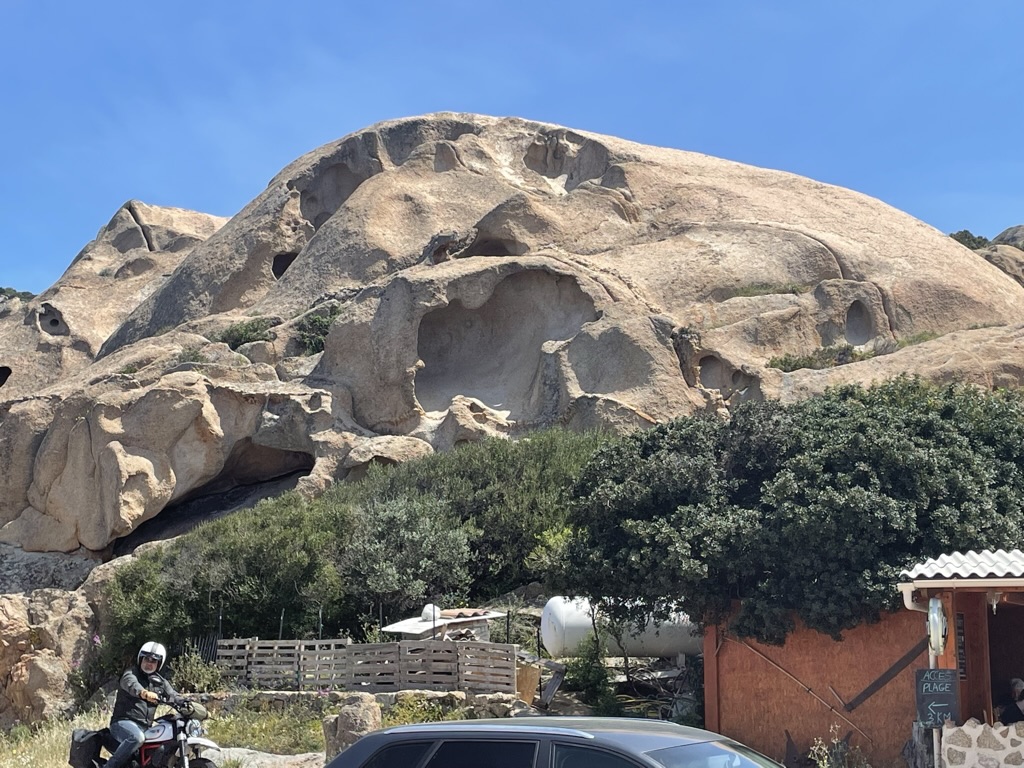
I dropped Denise and Coco off at the marina to grab a table at the well-reviewed Kissing Pigs restaurant and decided to widen my search for a spot. I ended up following the signs to a lot near the citadel and immediately regretted my decision: the car park was full and the only option was to detour through the narrow, tourist-filled streets of the old town. I was exactly the guy that everyone hates, driving through the part of town that cars should be banned from in the first place. Street parking is practically non-existent in Bonifacio and the few neighborhoods close to the harbor are militantly protective of their curbside real estate. I finally saw a hand-written sign a kilometer or two from the downtown advertising all-day parking and I turned down the narrow dirt street to find a shady character with a fist full of euros directing hapless tourists like myself into a dusty, makeshift lot. After 30 minutes of looking for a spot, I didn’t give a damn if I ever saw the car again and I gladly handed him the extortionary 15 euros and trekked back into town, only to find that our carefully-chosen, well-reviewed eaterie had closed down their kitchen for the afternoon. Luckily, Bonifacio is pretty much 90% restaurants by volume and we were able to quickly find a brassiere still serving and enjoyed a decent lunch with a nice view of the tour boats leaving the harbor.
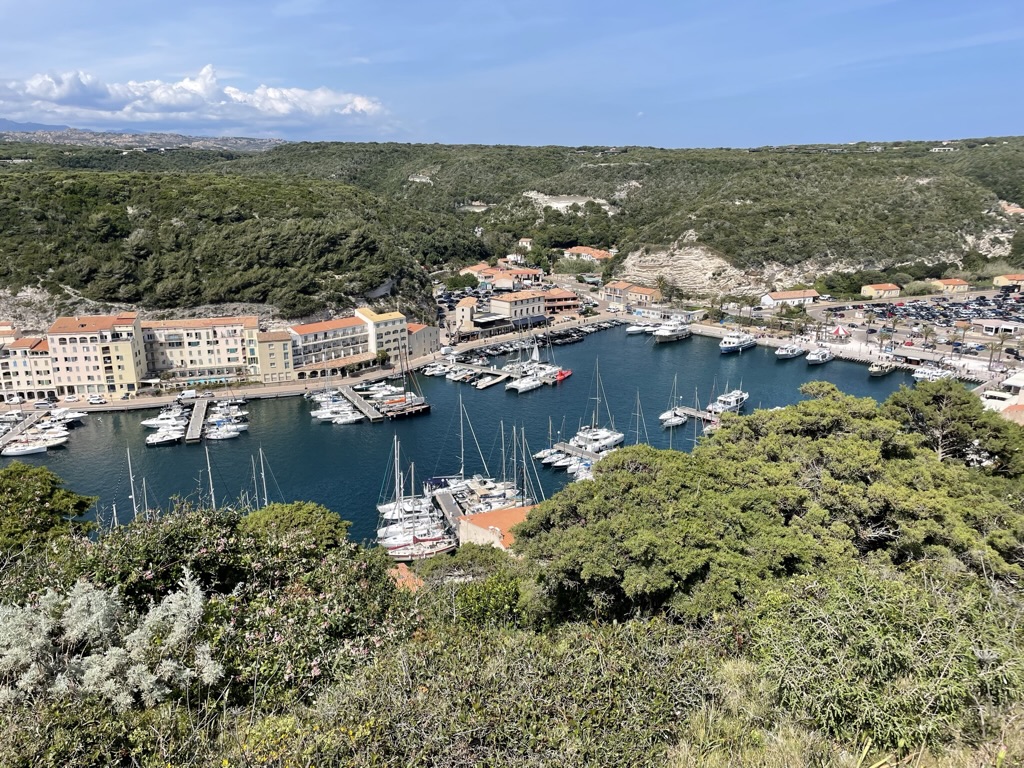
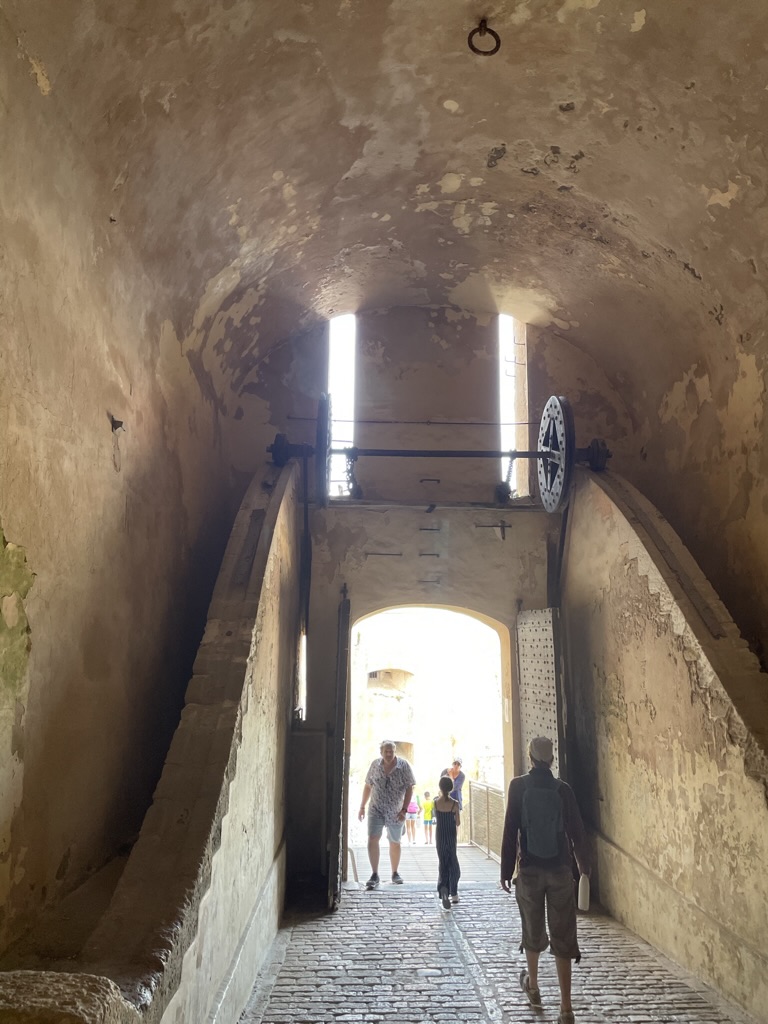
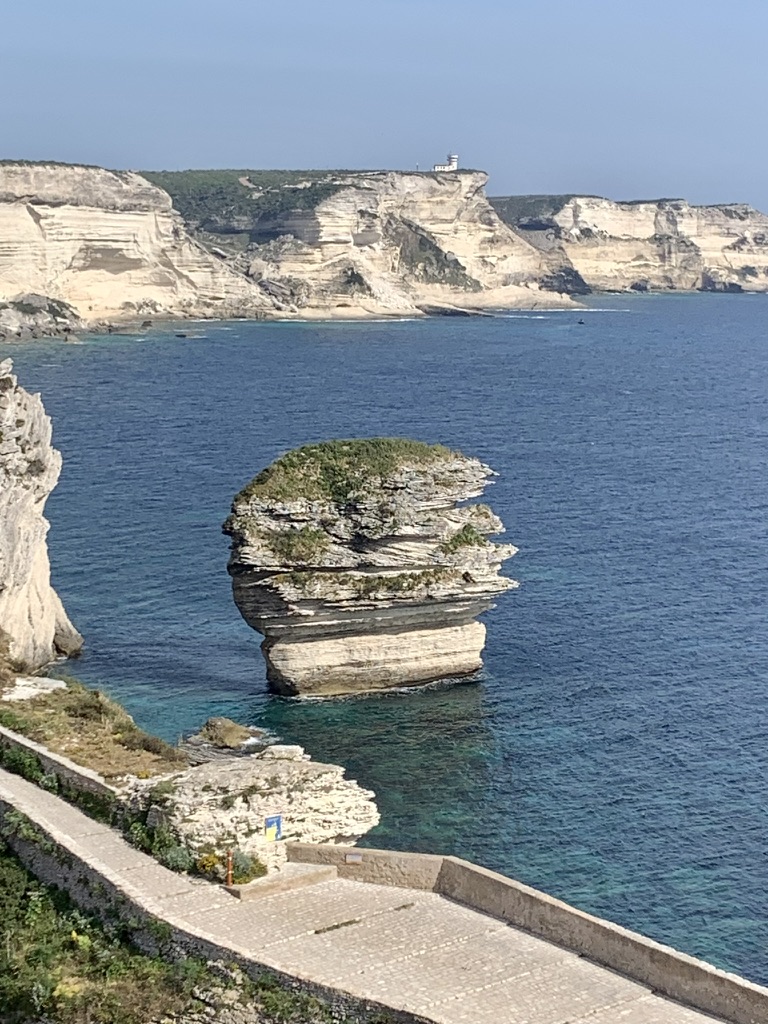
After a relaxing repast with a glass of the local white wine to de-stress me, we tackled the steep stairs that take you up to the old part of town and explored Le Grand Dieu, a scenic overlook that takes in the Strait of Bonifacio, Sardinia in the distance, and the citadel a la limestone. Then it was back down the rocky path and up the steep road to the drawbridge of the citadel. It’s an amazingly well-preserved fortress, unlike the old fort back in Ajaccio, and there’s even a set of steps from the ramparts, Staircase of the King of Aragon, carved into the limestone in 1420, that takes you down almost to the sea. When I read about it, I figured that it would only be available for viewing but you can, after paying five euros and donning a hard hat, walk the 188 steps down to just above the water. Denise was up for the challenge but I reminded her that you had to come back up the stairs too and she eventually saw my logic. If this was in America, there’s no way the town lawyers would allow you anywhere new those steps.
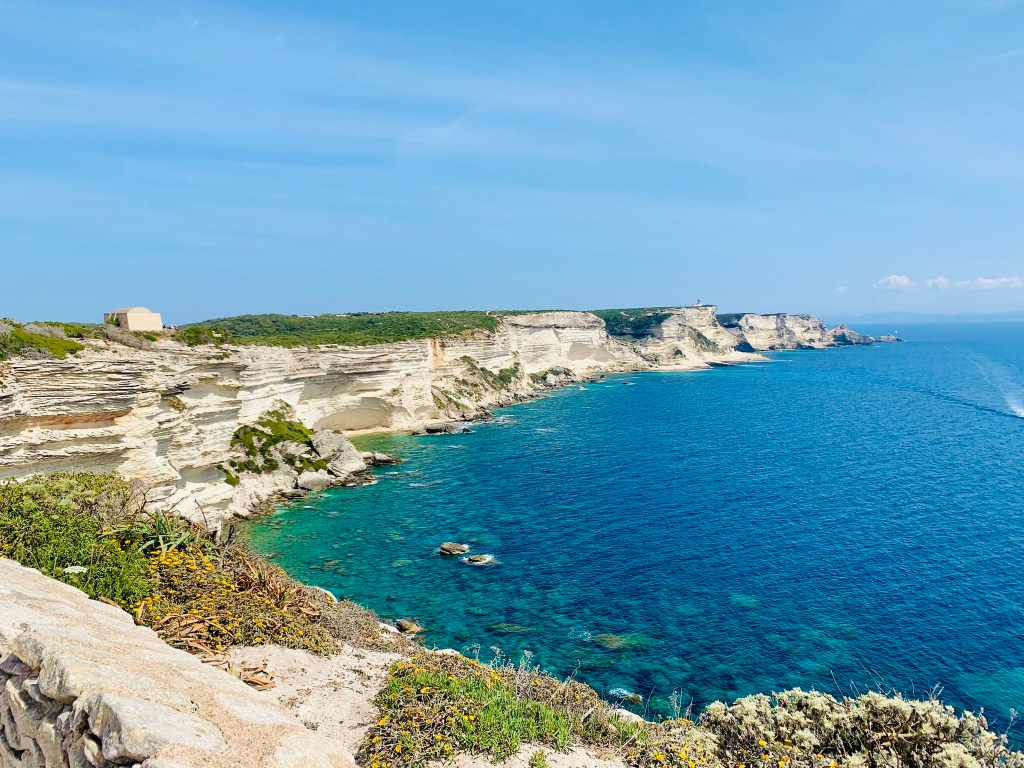
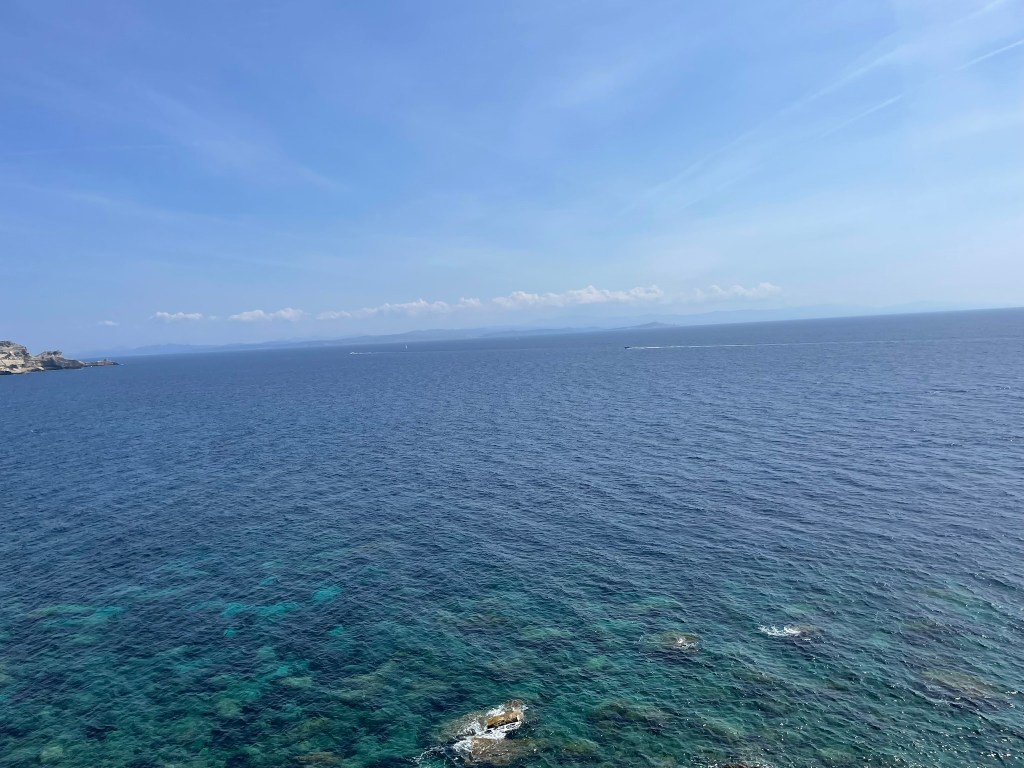
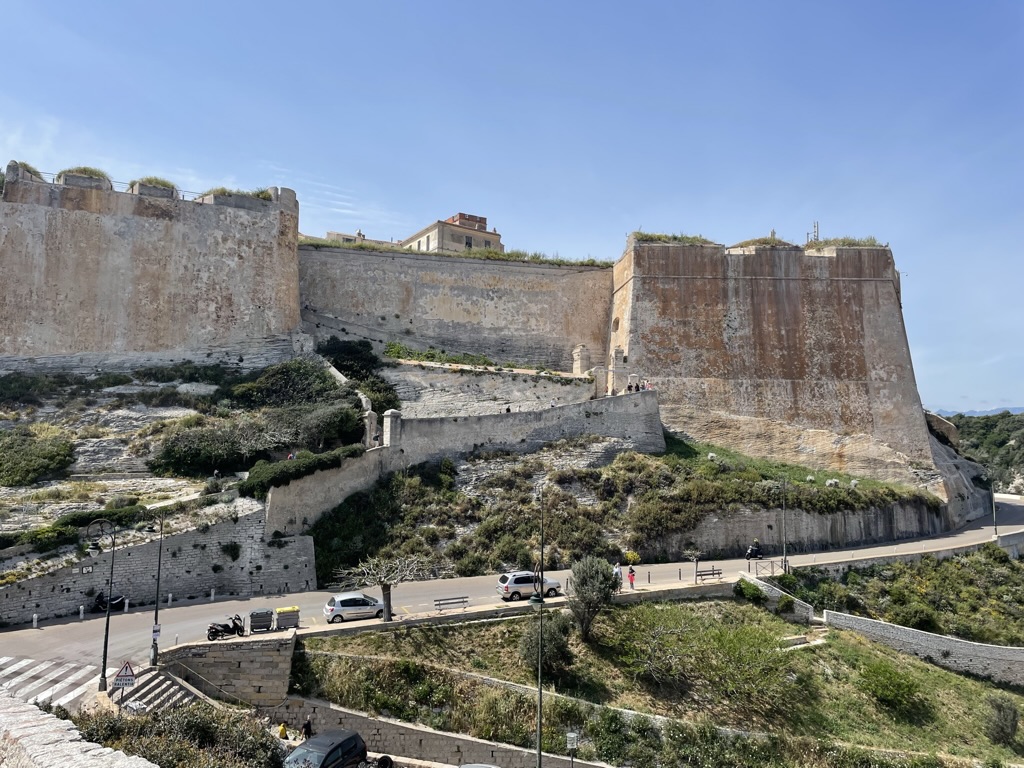
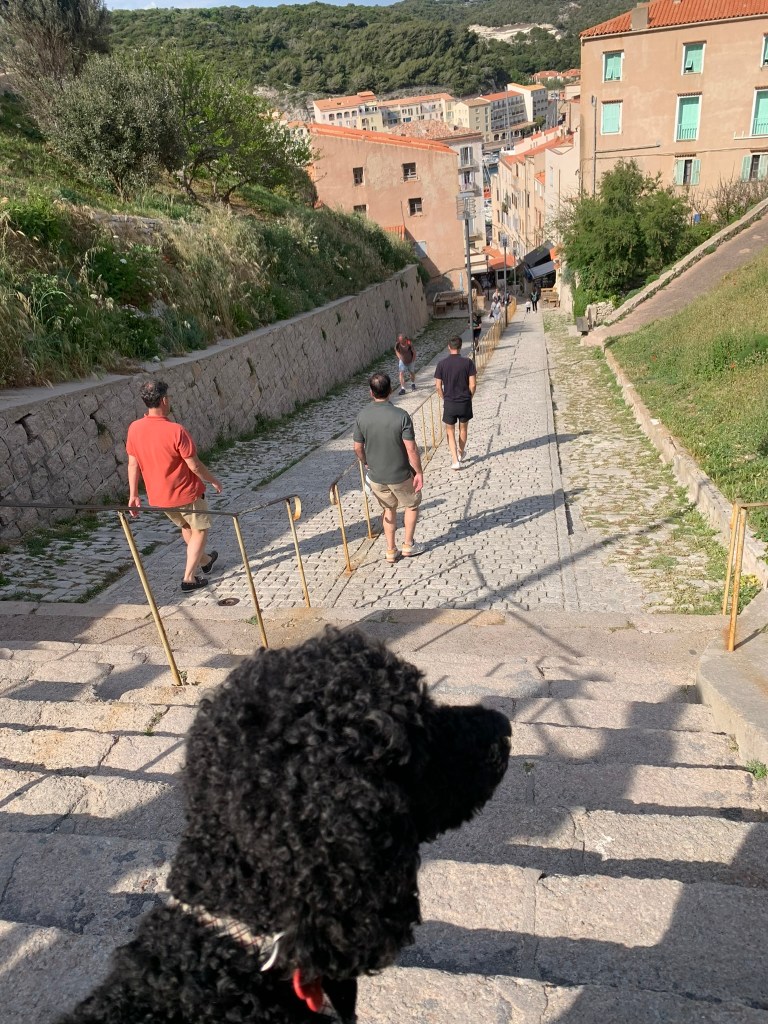
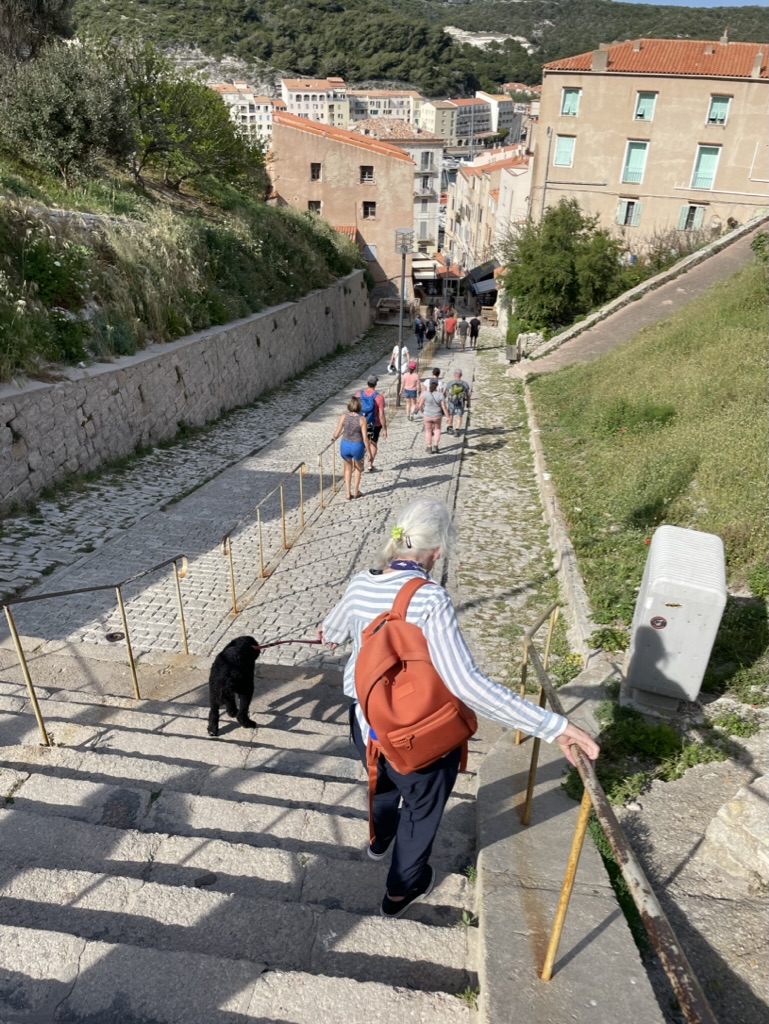
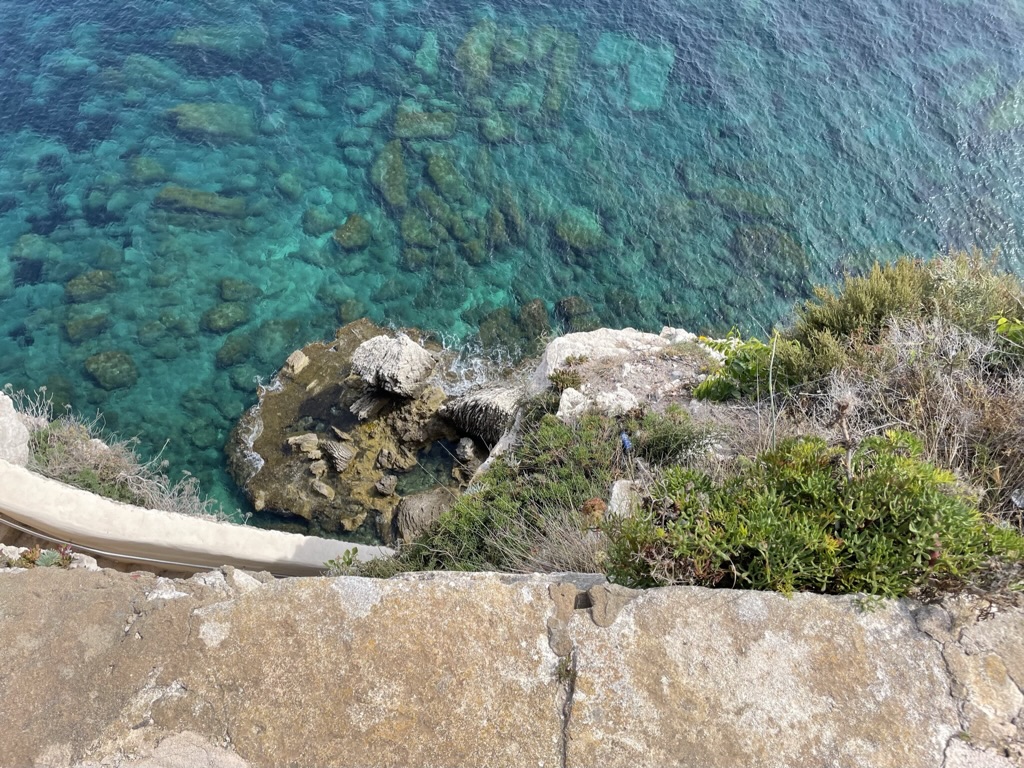
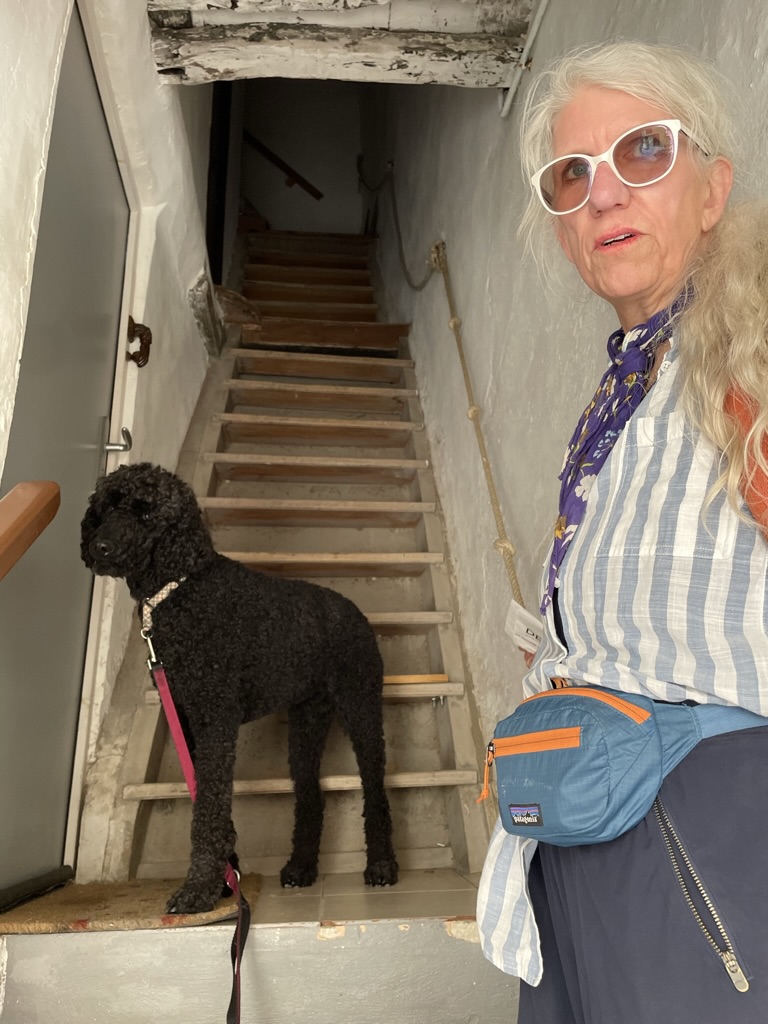
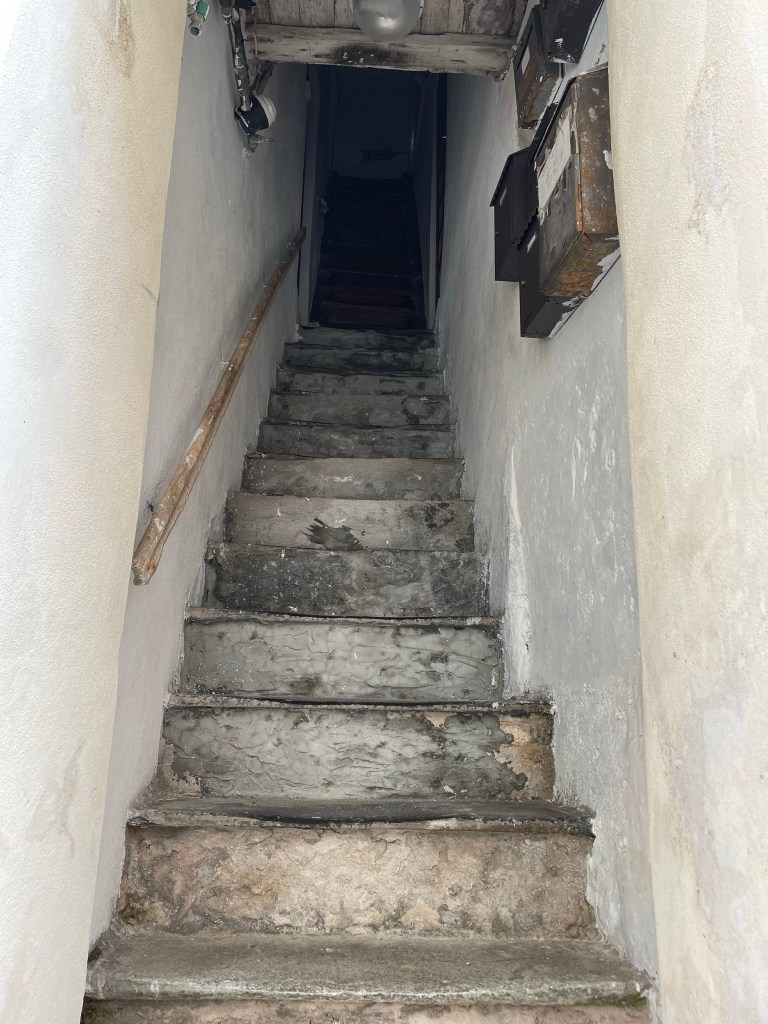
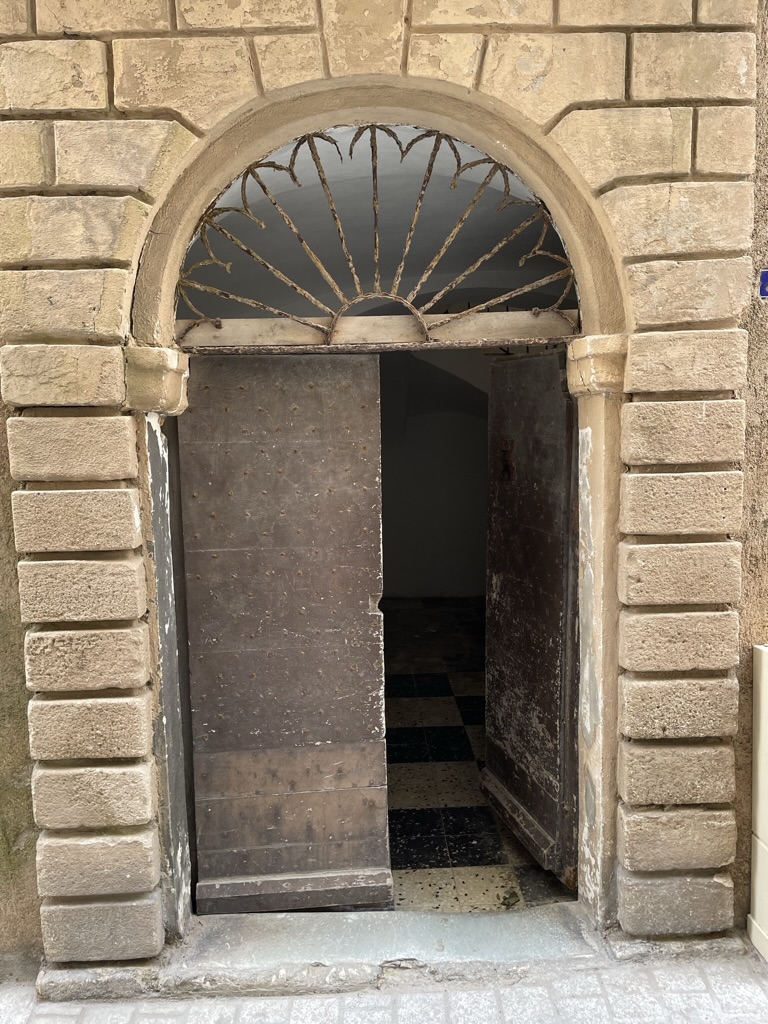
On the way back to the car, we detoured off the tourist streets to see where the 3000 or so residents of the city lived, and we discovered that the King’s staircase to the sea was not the most impressive in Bonifacio: the residential buildings lining the streets were mostly five-stories tall, and the staircases required to reach the top floors of these medieval-era apartments are so steep that the residents have rigged fixed ropes along the walls to help them make the ascent. Denise was trying to get a clear photo of these darkened stairwells when a resident, returning home from the market, pardonnez-ed past her and began scaling the stairs, one hand full of groceries, the other grabbing the rope for dear life and pulling herself up. After seeing what these people go through every day, we vowed we would never complain about the steps up to our street again. I hope the pictures do the place some justice because there’s no way that I can possibly describe how stunning Bonifacio is: if you are ever in the neighborhood, check it out.
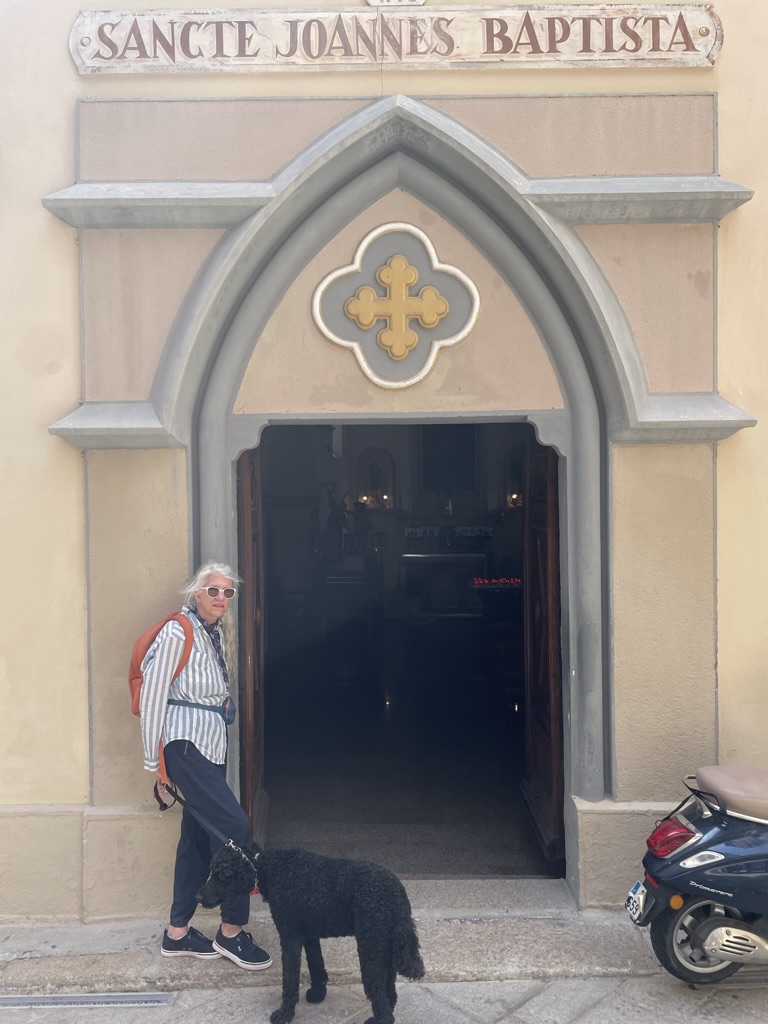
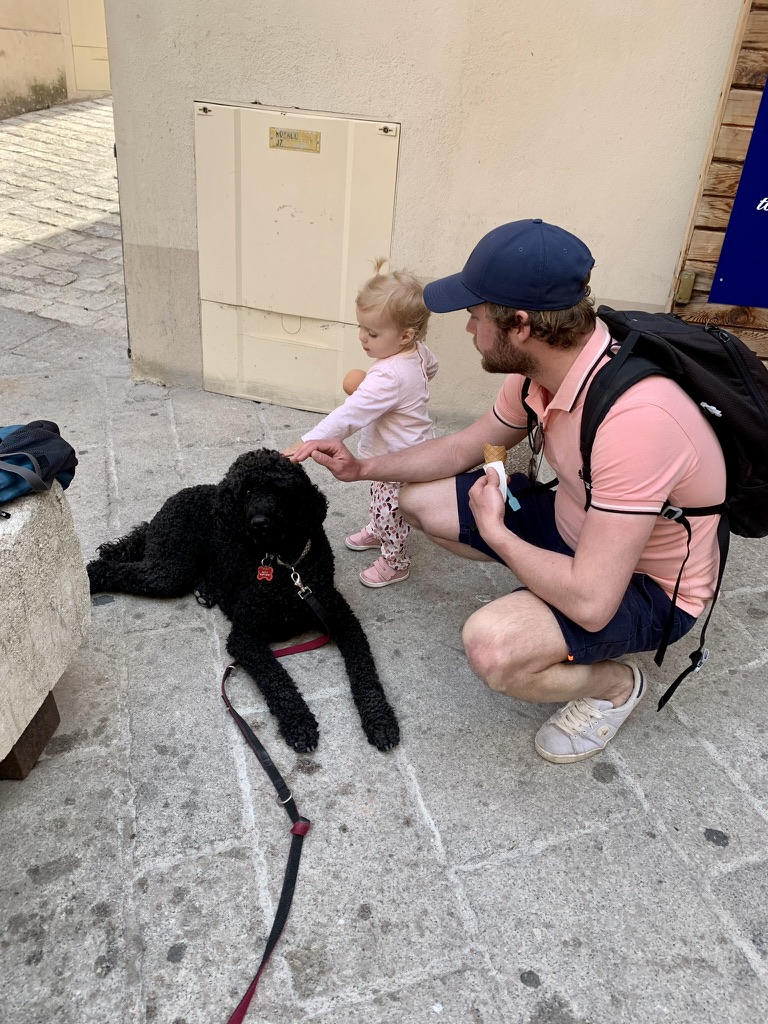
We then walked the 27 miles back to the makeshift parking lot to retrieve our car and began the long drive back to Ajaccio, first stopping off at a quiet plage to give Coco some ball-chasing time. On days like these, she gets her steps in and has plenty of admirers stop to say hello but she still needs her exercise. We then programmed our return route into our Citroën GPS, hoping to take a new set of roads home, thus avoiding the isolated interior mountain roads in favor of a more coastal route. Our English-accented GPS guide, however, had different plans for us.
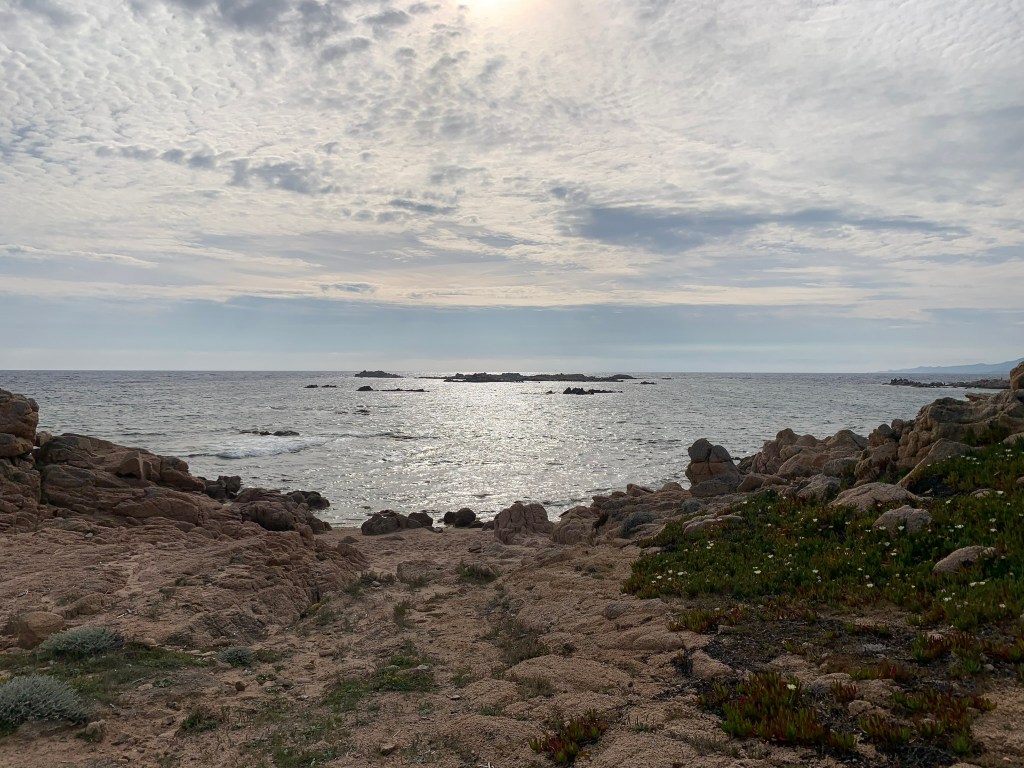
I should take a minute here to say that Calculating Route, the title of our blog, comes from an old family joke about our very first stand-alone GPS, bought in the early days of the technology, before modern cell phones and manufacturer-installed dashboard units. Our TomTom was a primitive, entry-level model that was always getting us more lost than we could have ever managed using paper maps. Whenever we missed a turn, thanks to the TomTom’s incredibly slow interface, the voice on the GPS would intone “calculating route… ” while leaving us hanging for new directions. Eventually, I got sick of it and, in a pique, threw it out the window of the car into a roadside ditch somewhere in rural California. I feel bad for anyone who may have found the discarded POS: they’re probably still wandering the roads, trying to get to their destination. Anyway, that’s the genesis of the name, along with the idea that we’re trying to find a place to settle down here. Now you’re up to speed and back to the story.
We entered the route home and then didn’t think any more about it, assuming that the guidance would keep us on our requested coastal route. About an hour into the trip however, we stopped for a bite to eat and realized that, somehow, the GPS had reset the route to take us back the exact same way we came. We were already too far to realistically turn back and find the correct road and, with darkness setting in, we decided to just plow on. The winding roads, challenging in daytime, became menacing in the twilight. There were no other cars on the road and the thought of breaking down or running off the road in this remote part of the country did not appeal. To make matters worse, we were running low on the gazole and the roads seemed to be all uphill, depleting our fuel quickly. At one point, a jackrabbit ran in front of the car and we began a comical, low-speed chase that lasted several minutes, with the bunny weaving and bobbing across the two lane road but never just simply avoiding danger by escaping into the low brush on either side of the road. At a certain point, we figured that le lapin was enjoying the game, and getting some training in case he was ever pursued by something more lethal than a C5 AirCross.
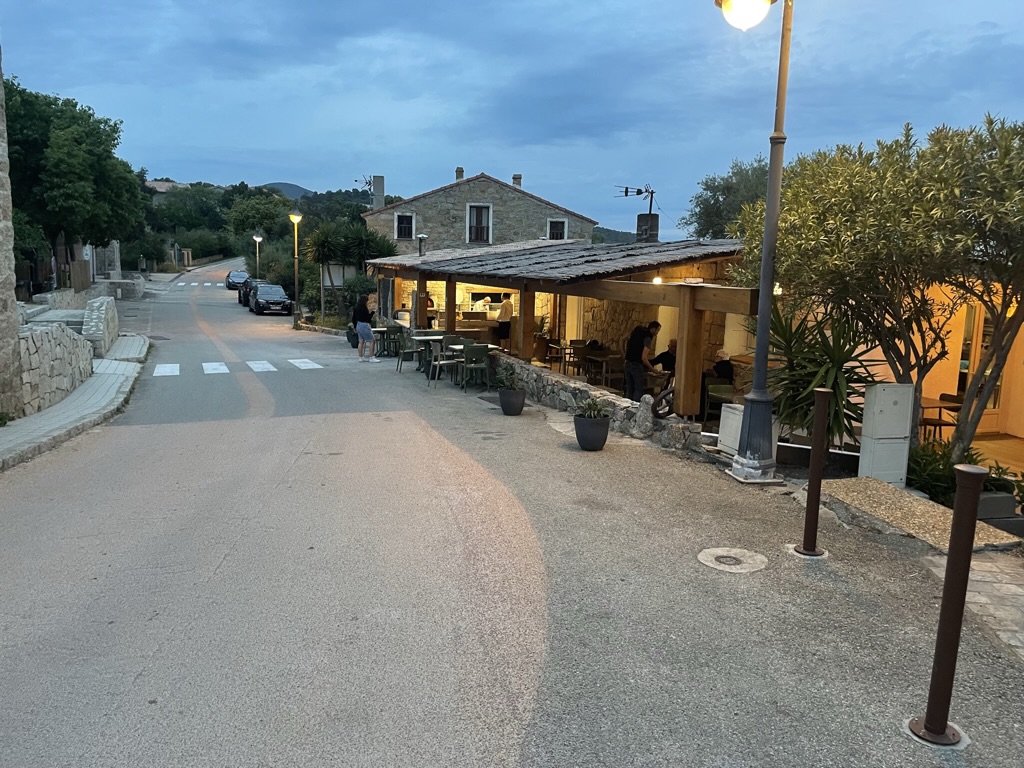
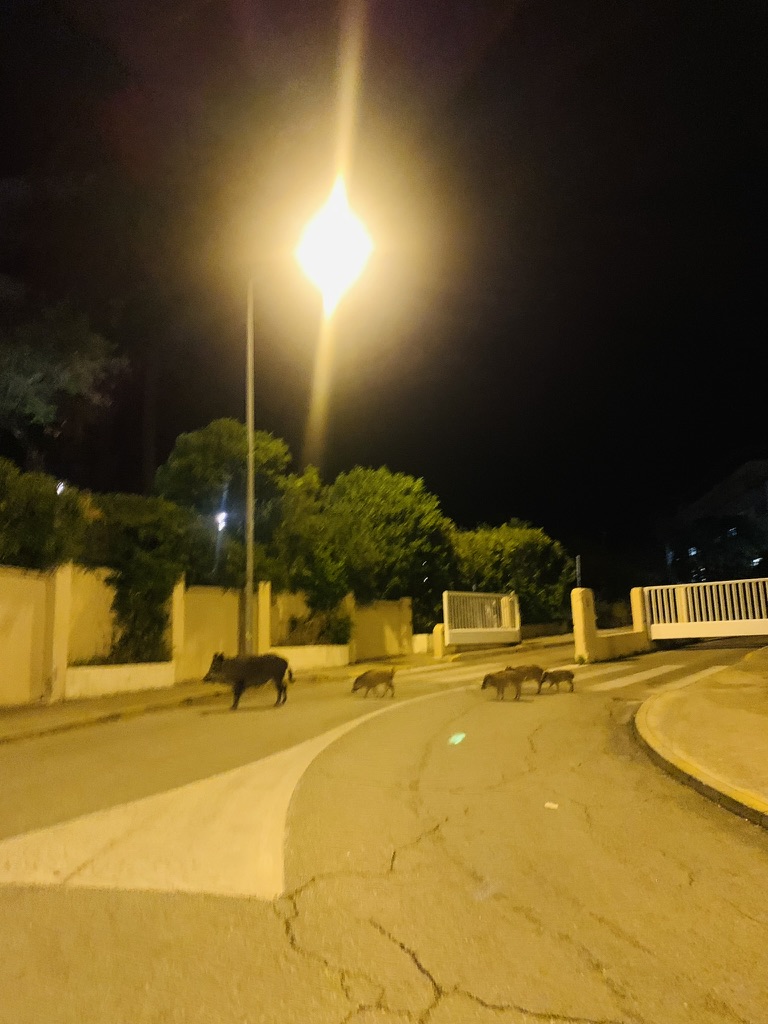
We finally arrived back to Ajaccio around 2200 hours and, as we made the last turn onto our street, our headlights caught a family of wild boars wandering across the road at the entrance to the decommissioned hospital near our house (now that I type that, I can picture a dystopian thriller with the boars occupying the abandoned facility and gradually learning how to practice medicine. Working title: Clinic of the Boars. I’ll keep you posted.). It was startling to see the sow and her little squeakers casually ambling along a city street as they are considered extremely dangerous animals in the wild. I tried to convince Denise to get out of the car and stand next to them for perspective but she wisely ignored me and shot these grainy pics from the safety of the passenger seat. In many cities, these animals are considered a nuisance and there had even been a city-sponsored hunt just before we arrived in town. Seeing something so wild in a city reminded me of some late night encounters with coyotes back in Portland: they didn’t pay much mind to us but I certainly wouldn’t want to mess with them. I was hoping to see a wild boar from a safe distance so I get to mark that on my Corsican BINGO card.
At the end of the day, the score read 1-2-2: a fun visit to one of the most scenic cities of Europe, with losses in the battles against the GPS and tourist parking, and standoffs with a jackrabbit and a sounder of boars. Not our best showing but we’ll do better in our upcoming trips to Cargése, Peri, and Corte. Don’t miss a minute of the exciting action.
 Calculating Route...

Thanks Steve and Denise for yet another view of this great adventure!
LikeLike
At least your trip wasn’t “boaring” 🤪
LikeLiked by 1 person